

A Brief History of Italian Immigration to America


Share This Post


A Brief History of Italian Immigration to America
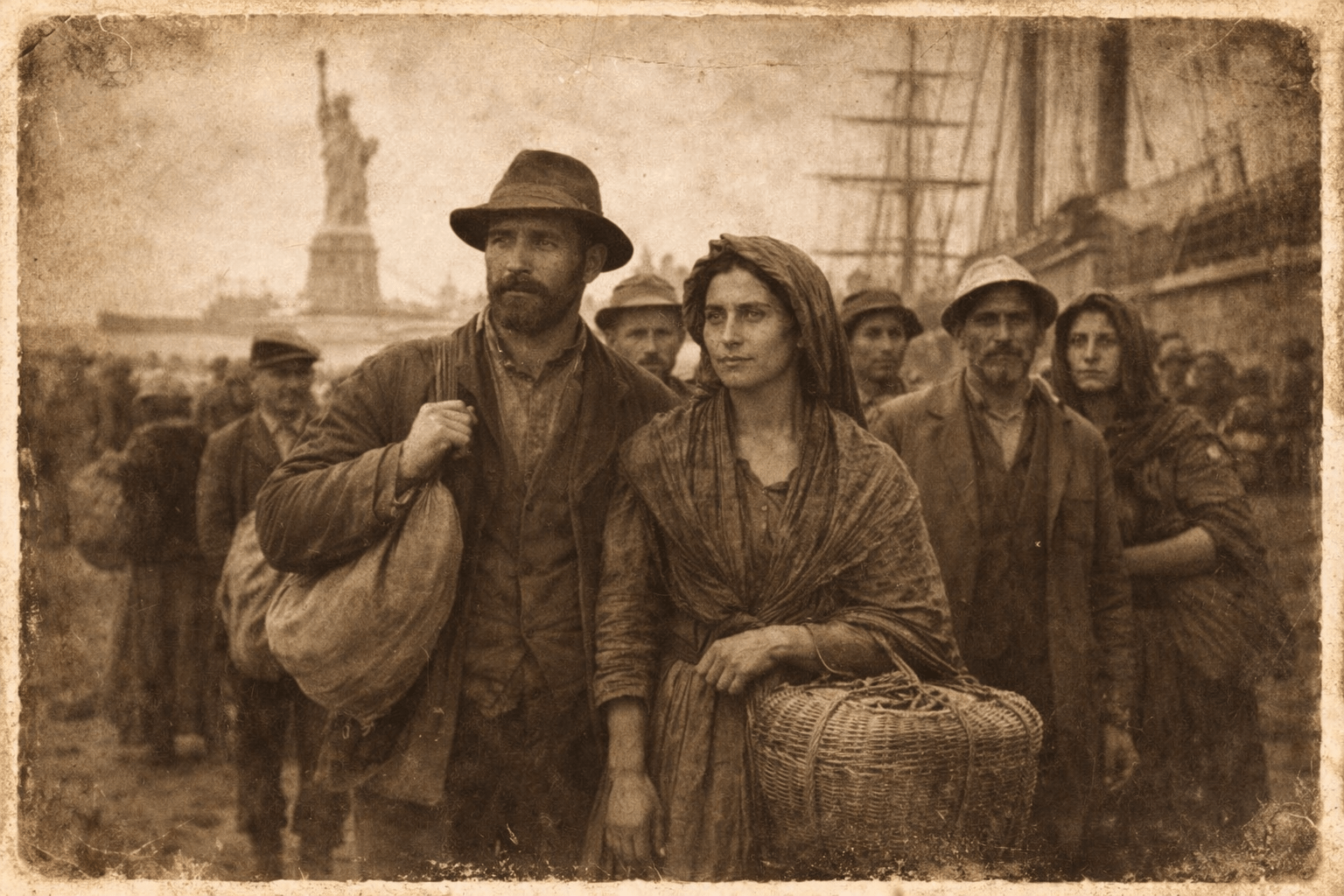
The story of Italian immigration to America is one of movement, struggle, adaptation, and renewal. Over the course of more than a century, millions of Italian immigrants crossed the Atlantic, reshaping both the United States and their own sense of identity. What began as small, scattered arrivals became one of the largest mass migrations in modern history.
Today, renewed interest in heritage and citizenship reflects how deeply the immigration of Italians to America continues to influence family histories across generations.
Before the Mass Migration: Italians in Early America
Italian immigration in the United States did not begin at Ellis Island. Long before the great waves of the late nineteenth century, smaller numbers of Italians had already settled in America. Many were skilled artisans, musicians, merchants, and stonemasons who brought specialized trades to a young and growing nation.
From 1820 to 1870, no more than 25,000 Italians arrived in the United States. These early migrants were often from northern regions and settled in diverse places, including New Jersey, California, Louisiana, and New York. While their numbers were modest, they laid early foundations for the much larger migration that would follow.
Why Millions Left Italy
The great era of Italian immigration to the USA began in the 1880s and lasted until the early 1920s. During this period, over four million Italians arrived in the United States.
Several factors drove the immigration of Italians to the US. Italy had unified politically in 1861, but economic conditions remained uneven. In southern Italy and Sicily, poverty, land shortages, natural disasters, and limited industrial development pushed many families to seek opportunity elsewhere. Population growth intensified competition for farmland and employment.
At the same time, transatlantic travel became more affordable and efficient. Steamship companies advertised widely, and letters from earlier migrants described wages that far exceeded what could be earned at home. Many young men traveled alone, intending to work temporarily and send money back to their families. In fact, a significant portion eventually returned to Italy, creating a pattern of circular migration that defined this period of Italian immigration to America.
Arrival and Inspection: The Gateway Experience
For many newcomers, the journey culminated at Ellis Island in New York Harbor, which opened in 1892. There, immigrants underwent medical inspections and legal questioning. Officials examined arrivals for contagious diseases and assessed whether they had the means or employment prospects to support themselves.
Although the vast majority were admitted, the process could be stressful and uncertain. For countless Italian immigrants, Ellis Island was viewed as a powerful symbol of hope.
Rebuilding Community in American Cities
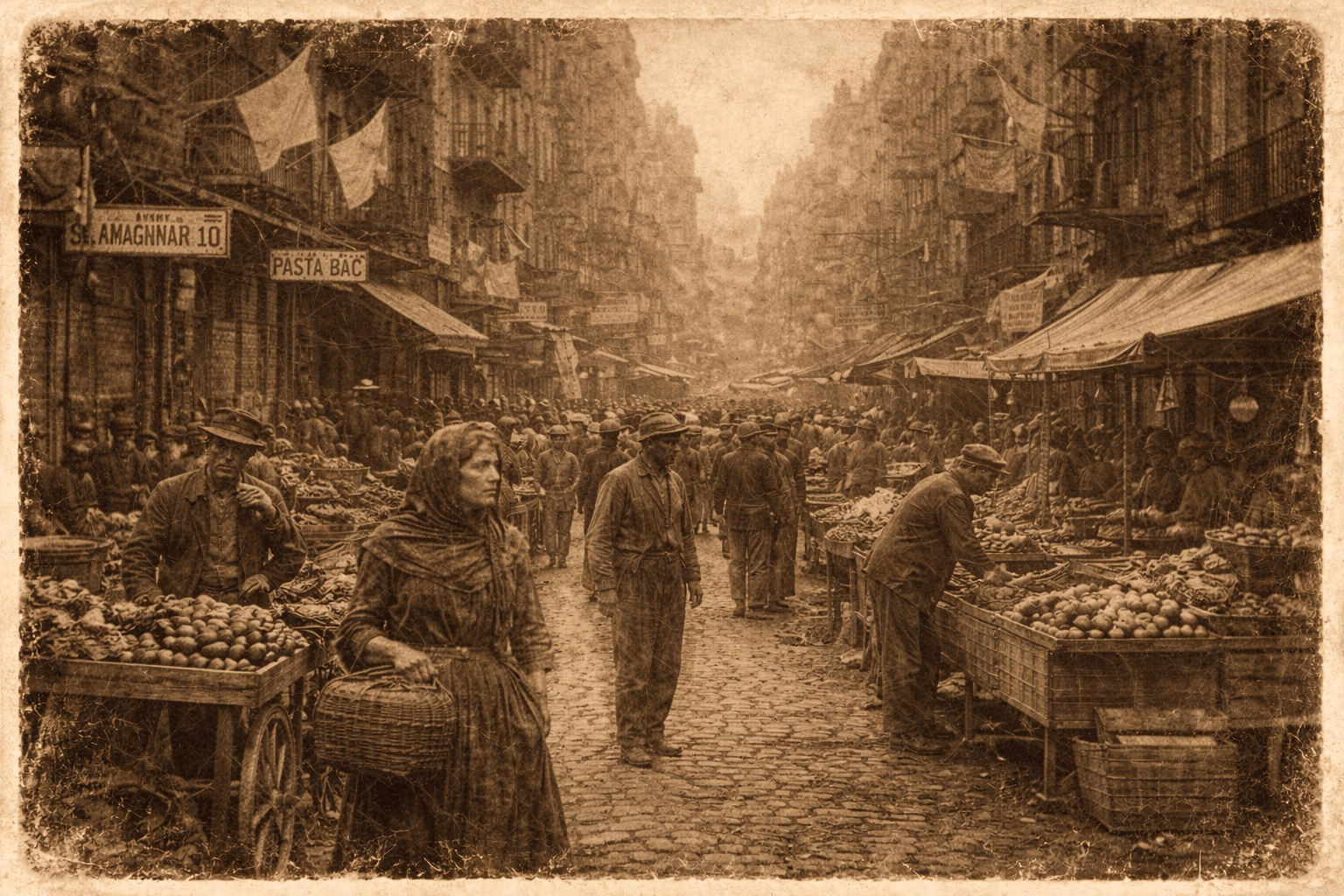
Italian immigration in the United States did not produce a single unified community. Many newcomers identified more strongly with their village or region than with a national Italian identity, which was still relatively new. As a result, urban neighborhoods often became clusters of families from the same towns in Sicily, Campania, Calabria, or other regions.
These neighborhoods—later known as Little Italies—were supported by parish churches, mutual aid societies, and hometown associations. Such institutions provided job connections, financial assistance, and cultural continuity. Over time, children born in America blended regional traditions into a broader Italian American identity, marking a gradual shift from village-based loyalties to a shared ethnic identity.
Hardship, Labor, and Mobility
Life for many Italian immigrants was difficult, especially in crowded urban tenements. Apartments were often small and poorly ventilated, and sanitation systems were inadequate. Families sometimes shared tight quarters, and disease spread easily in densely populated neighborhoods.
Work was equally demanding. Italian immigrants labored in construction, factory work, mining, agriculture, quarrying, dock work, and railroad building. Women and children often contributed to household income through factory labor or piecework performed at home. In some regions, labor brokers known as padroni controlled hiring and wages, sometimes exploiting vulnerable workers.
Yet the story of Italian immigration to the USA is also one of mobility. Across the country, Italians worked in vineyards, fisheries, farms, and quarries. Some became entrepreneurs, establishing businesses (such as the Contadina tomato sauce company) and financial institutions. Over generations, access to education and skilled trades enabled many families to move into the middle class.
Backlash and Restriction
Italian immigrants often faced prejudice and discrimination. In some cases, hostility turned violent. In 1891, after the acquittal of several Italian immigrants accused of killing New Orleans police chief David Hennessy, a mob stormed the parish jail and murdered 11 Sicilian men—one of the largest mass lynchings in American history.
Anti-immigrant sentiment often portrayed southern and eastern Europeans as culturally inferior or politically radical, reinforcing suspicion and exclusion. This climate of suspicion contributed to federal immigration restrictions in the 1920s. The Immigration Act of 1924 established strict quotas that sharply reduced arrivals from southern and eastern Europe, including Italy.
From Margins to Mainstream
Over time, the story of Italian immigration in the United States shifted from hardship and exclusion to leadership and influence. The children and grandchildren of Italian immigrants moved into public life, business, science, sports, and the arts.
Notable Italian-American figures include:
- Fiorello La Guardia – Reform-minded mayor of New York City (1934–45)
- Frank Sinatra – Legendary singer and actor who helped define American popular music
- Joe DiMaggio – Hall of Fame baseball player and one of the most celebrated athletes of the twentieth century
- Enrico Fermi – Nobel Prize–winning physicist who played a key role in early nuclear research in the United States
- Lee Iacocca – Auto industry executive who helped reshape Chrysler in the late twentieth century
- Martin Scorsese – Acclaimed filmmaker whose work powerfully influenced modern American cinema
Large-scale Italian immigration to America resulted in a deeply rooted community whose contributions became part of the nation’s mainstream culture, even as many families continued to preserve strong ties to their heritage.
Citizenship by Descent and the Modern Legal Framework
The history of Italian immigration to the USA remains relevant today because Italy’s citizenship system has long emphasized descent. Under the principle of jure sanguinis, citizenship can pass from parent to child across generations, provided that certain conditions are met. This legal approach reflects Italy’s recognition of its global diaspora, including descendants of those who participated in the great immigration of Italians to the US.
Key legal developments shaped how citizenship is transmitted. Early twentieth-century nationality laws formalized descent-based citizenship. After 1948, Italy’s constitutional framework supported equal transmission of citizenship through mothers, while certain earlier maternal-line cases required judicial review. Law No. 91 of 1992 remains the foundation of modern Italian nationality law.
More recently, Law 74/2025 introduced new criteria and limitations that affect some individuals born abroad. As a result, eligibility today depends on specific family timelines and documentation.
Those seeking guidance through today’s evolving legal framework can contact the Italian American Citizenship Assistance Program (ITAMCAP). We provide a range of Italian citizenship assistance services, including document translation and acquisition of vital records.